
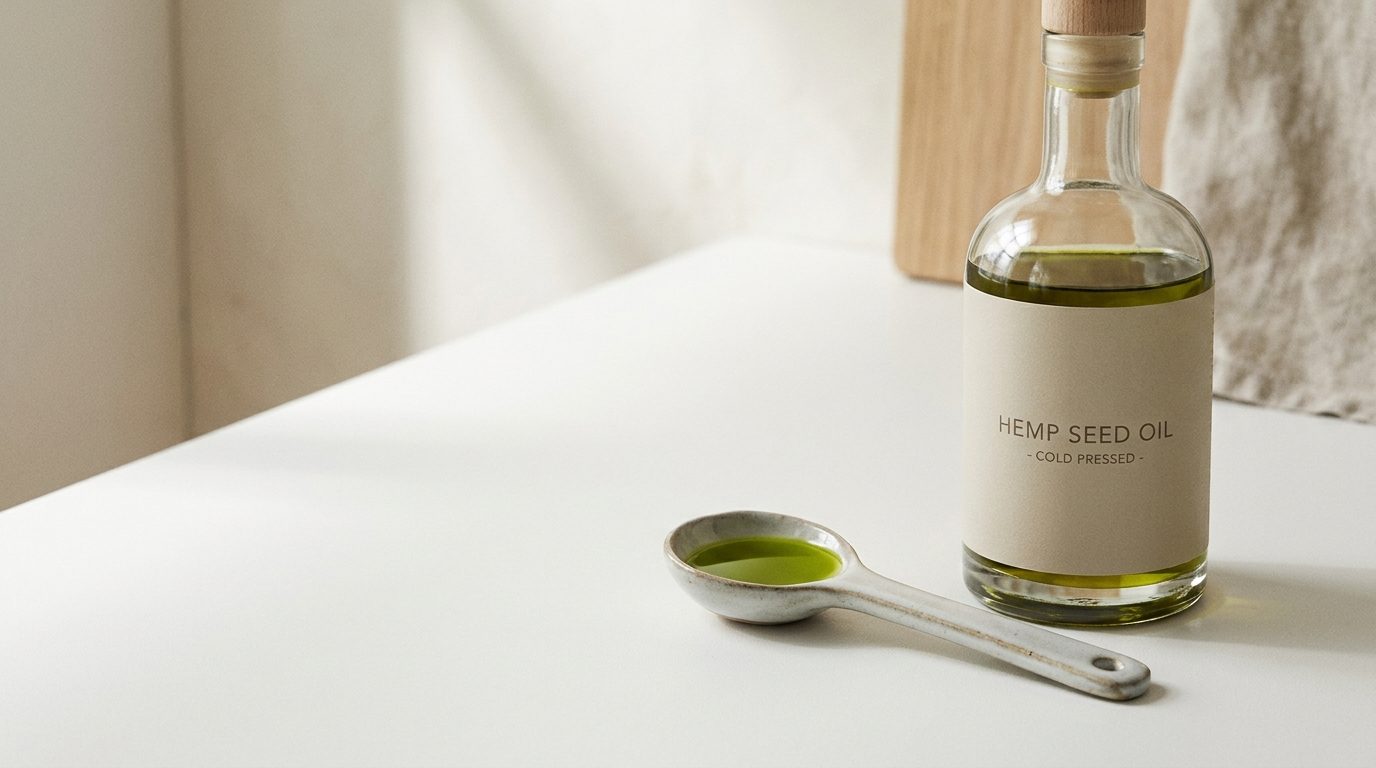
Almost every source tells you to take "one to two tablespoons of hemp seed oil a day," then stops. That advice ignores the two things that actually decide your dose: how much you weigh and why you are taking it in the first place. This guide turns the vague tablespoon into concrete grams, calories, and omega-3 you can match to your own situation.
What is in one serving, exactly?
Before scaling a dose, it helps to anchor on a single standard serving. One tablespoon of cold-pressed hemp seed oil is about 14 grams. That same tablespoon delivers roughly 126 calories, all of it from fat, and around 2.5 grams of omega-3 in the form of alpha-linolenic acid (ALA). It also carries about 8 grams of omega-6 (mostly linoleic acid plus a little gamma-linolenic acid), which keeps the overall omega-6 to omega-3 ratio near 3:1.
Those four numbers (grams, calories, ALA, and the omega ratio) are the levers behind every dosing decision. The fat and calorie load sets an upper limit on how much fits sensibly into a day; the ALA content sets a lower limit on how much you need to make a nutritional difference. A useful dose lives between those two lines.
How much hemp seed oil per day, by body weight?
There is no official "recommended daily intake" for hemp seed oil specifically, because it is a food rather than a regulated supplement. What we can scale by body weight is the omega-3 it provides, since ALA needs are loosely tied to body size and overall energy intake. Lighter bodies need less to reach a meaningful top-up; heavier bodies have more dietary room before the calories matter.
The table below gives a practical daily range for two common goals. The "general nutrition" column is a gentle daily addition that improves your fat quality without much thought to calories. The "omega top-up" column is for people deliberately leaning on hemp oil as a plant source of omega-3, typically because they eat little or no fish.
| Body weight | General nutrition (daily) | Omega top-up (daily) | ALA omega-3 at top-up | Calories at top-up |
|---|---|---|---|---|
| Under 55 kg (120 lb) | 1 tsp – 1 tbsp | 1 tbsp (14 g) | ~2.5 g | ~126 |
| 55–70 kg (120–155 lb) | 1 tbsp | 1–1.5 tbsp (14–21 g) | ~2.5–3.8 g | ~126–190 |
| 70–90 kg (155–200 lb) | 1 tbsp | 1.5–2 tbsp (21–28 g) | ~3.8–5 g | ~190–252 |
| Over 90 kg (200 lb) | 1–1.5 tbsp | 2 tbsp (28 g) | ~5 g | ~252 |
Two tablespoons a day is a sensible upper bound for nearly everyone. It is not a safety ceiling (hemp oil is just food), but beyond that point you are mostly adding calories rather than filling a nutritional gap, and the practical return diminishes.
Does your goal change the dose?
It changes it more than your body weight does. The same bottle serves very different purposes, and each one points to a different amount.
- General nutrition and fat-quality upgrade. Here the aim is simply to replace some of the omega-6-heavy oils in your diet (sunflower, corn, soybean) with something better balanced. One tablespoon a day, used in dressings or drizzled over finished food, does this comfortably. The goal is balance, not volume.
- Plant-based omega-3 top-up. If you do not eat fish, hemp oil is one way to raise your ALA intake. This is the goal that justifies the upper end of the table, 1.5 to 2 tablespoons, because you are leaning on it as a meaningful source rather than a garnish.
- Skin and barrier support from the inside. The fatty acids in hemp oil are sometimes taken to support skin hydration and barrier function. One tablespoon daily is the usual amount; this is a slow, cumulative effect measured over weeks, so more per day does not speed it up.
- Cooking flavour only. If you just like the grassy, nutty taste as a finishing oil, dose by the dish, not by the day. A teaspoon over hummus or a tablespoon in a vinaigrette is about taste, and any nutritional benefit is a bonus.
A reality check on the omega-3 you are actually getting
This is the part most dosage advice quietly skips. Hemp oil's omega-3 is ALA, the plant form. Your body has to convert ALA into the longer-chain forms (EPA and DHA) that do much of the work linked to omega-3, and that conversion is inefficient in humans, with only a small fraction making the journey. The exact rate varies between individuals, but it is low across the board.
The practical takeaways:
- Hemp oil is a genuine source of ALA, and the 2.5 grams in a tablespoon meaningfully contributes toward common daily ALA targets for adults.
- It is not a direct substitute for fish or algae oil if your specific goal is raising EPA and DHA, because the conversion bottleneck stands in the way.
- Taking a larger dose does not fix the conversion limit. Doubling the oil does not double the EPA your body makes; it mostly doubles the calories.
So the honest framing is this: hemp oil dosing is about improving the balance and quality of the fats you eat, not about megadosing a single nutrient. That is exactly why one to two tablespoons is the sensible window, and why pushing past it has limited payoff.
How to fit the calories in without thinking about it
A tablespoon is 126 calories, and two tablespoons is around 250, roughly the same as a generous handful of nuts. That is not trivial if you are watching your intake, but it is easy to manage when the oil replaces another fat rather than piling on top of one.
- Swap, do not stack. Use hemp oil in the salad dressing instead of olive or canola, rather than in addition to your usual oils. The calories were already in your day; you have only upgraded the fat profile.
- Split a larger dose. If your goal puts you at two tablespoons, take one at lunch and one at dinner. It is gentler on digestion and easier to absorb into normal meals than a single morning shot.
- Never heat your dose. Hemp oil is a finishing oil. Cooking with it destroys much of the ALA you are dosing for, so the omega-3 you carefully measured ends up degraded. Add it after the heat is off.
- Take it with food. Fat-soluble nutrients absorb best alongside a meal, and a tablespoon stirred into yogurt, blended into a smoothie, or whisked into a vinaigrette goes down far more pleasantly than a straight spoonful.
Who should adjust or skip the standard dose?
The body-weight table is a starting point for healthy adults, not a prescription. A few situations call for a different approach.
- Children. Scale down with body weight; a teaspoon is plenty for a small child, and food is generally the better vehicle than a measured supplement dose.
- Anyone on blood-thinning medication or with a bleeding disorder. Omega-3 fats can have a mild effect on clotting at higher intakes. This is worth a conversation with your own healthcare provider before you settle on a daily amount, rather than self-prescribing the top end.
- Sensitive digestion. Any oil taken in quantity on an empty stomach can loosen the gut. If a full tablespoon is too much at once, start at a teaspoon and build up over a week or two.
- Calorie-restricted diets. If every calorie is accounted for, lean toward the general-nutrition column and make sure the oil is replacing another fat, not adding to your total.
Hemp seed oil is a food, and food does not need to be micro-dosed to be useful. Pick the row that matches your weight, choose the column that matches your goal, and keep it in the one-to-two-tablespoon window. Buy the oil in dark glass, keep it cold, and use it fresh within a few months of opening, because rancid oil delivers none of the omega-3 you measured out so carefully. If you want to go deeper on the omega balance, storage, or culinary side of hemp oil, the rest of the collection is in the article index.