
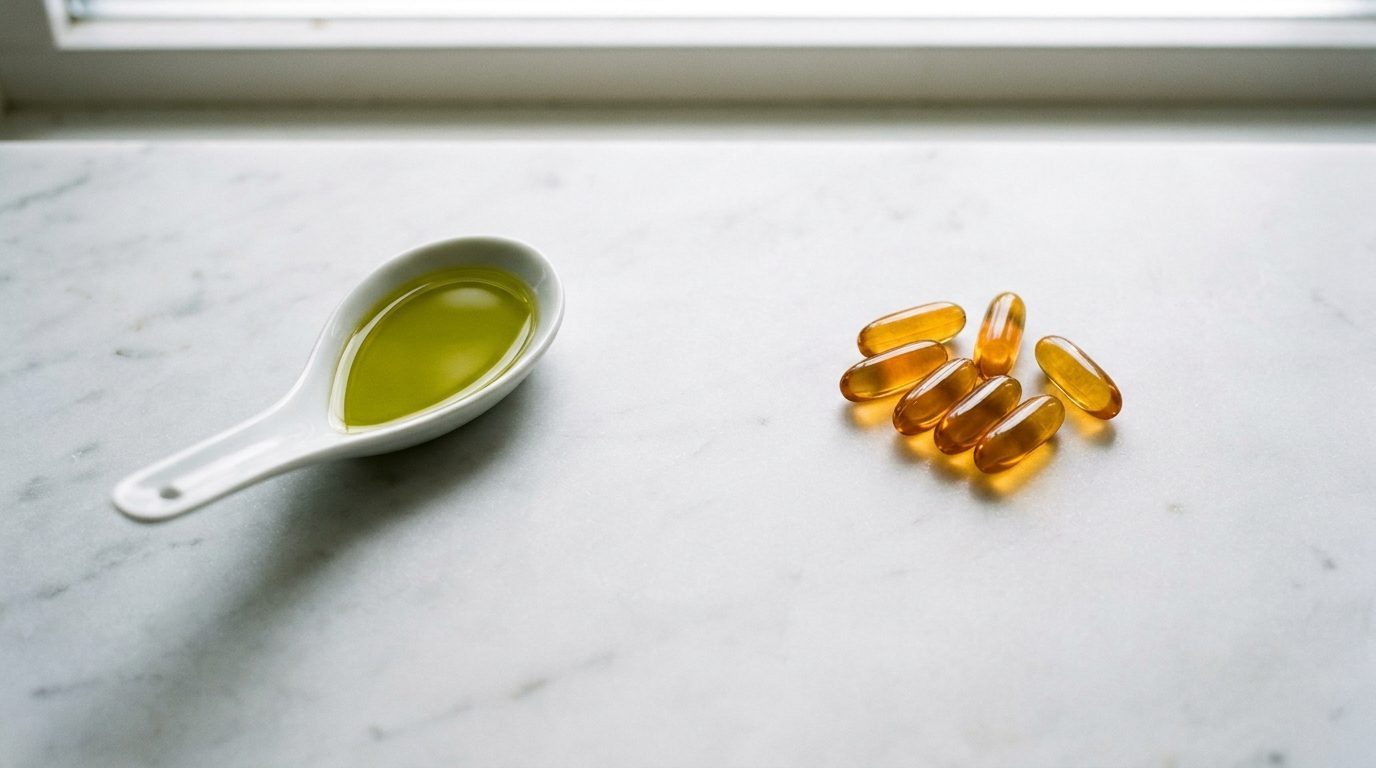
The question comes up every time someone opens a bottle of hemp seed oil and reads the words "omega-3" on the front: can this quietly replace the fish oil capsules? The honest answer is that it covers part of the job and not all of it.
What fish oil supplies that hemp oil does not
Fish oil supplements are valued for two long-chain omega-3 fatty acids, EPA and DHA. Those are the forms most directly used in cell membranes and signalling, and they are the forms most human research has focused on. Fish do not manufacture them from scratch either — they accumulate them from algae up the food chain.
Hemp seed oil contains no meaningful EPA or DHA. Its omega-3 is alpha-linolenic acid (ALA), the short-chain plant form, along with traces of stearidonic acid. ALA is genuinely essential: your body cannot make it, and it has roles of its own. But if you were taking fish oil specifically to raise EPA and DHA, swapping in hemp oil is not a like-for-like substitution.
How much ALA actually becomes EPA and DHA?
Human bodies can elongate and desaturate ALA into EPA and, further along, into DHA. The pathway works — it is just inefficient. Conversion to EPA is generally modest, often described as a small single-digit percentage of intake, and conversion onward to DHA is lower still, in some people close to negligible.
Several things push that efficiency around:
- Competing omega-6. Linoleic acid uses the same enzymes as ALA. A diet loaded with omega-6-rich oils keeps those enzymes busy, leaving less capacity for ALA.
- Genetics. Variation in the desaturase genes means two people eating identical diets can end up with quite different long-chain omega-3 levels.
- Sex and life stage. Conversion to DHA appears to run higher in women of reproductive age, which is generally read as an adaptation to pregnancy demands.
- Overall diet quality. Protein, certain micronutrients and total energy intake all feed into how well the pathway runs.
The practical upshot: eating more ALA does raise EPA somewhat, but you cannot reliably force DHA up through ALA alone.
The stearidonic acid footnote
Hemp seed oil contains a small amount of stearidonic acid, an omega-3 that sits one step past the slowest point in the conversion chain. In principle that makes it a more efficient starting material than ALA. In practice the quantity in a tablespoon of hemp oil is small, so treat it as an interesting compositional detail rather than a workaround for the conversion bottleneck.
Who genuinely needs preformed EPA and DHA?
If you eat oily fish regularly, you are already getting preformed EPA and DHA and hemp oil is simply a good additional food fat. If you eat no fish at all — vegetarian, vegan, allergic, or you just do not like it — then relying on conversion alone leaves DHA as the weak link, and that is worth taking seriously rather than assuming a spoon of seed oil covers it.
Pregnancy, breastfeeding, infancy and any clinician-directed use of omega-3 are all situations where the specific form matters and where guesswork is a poor plan. Those are conversations for a dietitian or physician who knows your diet and your bloodwork, not for a label on a bottle.
Algal oil: the plant-based answer to the DHA gap
Algae are where the marine omega-3s originate, and algal oil supplements deliver DHA — often with some EPA — without going through a fish. For someone avoiding fish oil on dietary, ethical, allergy or taste grounds, algal oil is the direct replacement, and hemp seed oil is the food-level complement rather than the substitute.
Thinking of it as two separate roles makes the decision easier. Algal oil handles the long-chain omega-3 supply. Hemp oil handles day-to-day fat quality: it brings ALA, a small amount of GLA, vitamin E and a far better omega-6 to omega-3 balance than the oils it usually displaces.
What hemp seed oil is genuinely good at
It is easy to undersell hemp oil while correcting the fish oil claim. Used as a finishing oil, it improves the fat composition of meals you are eating anyway, adds a green nutty flavour that makes vegetables and grains more appealing, contributes ALA in a form your body can use for its own purposes, and provides a rare dietary source of GLA. It also does not taste of fish, does not repeat on you, and does not need to be swallowed as a capsule.
A workable plan for most people looks like this: keep hemp seed oil in the fridge as your everyday cold-use oil, cut back on the refined omega-6-heavy oils competing for the same enzymes, and if you eat little or no fish, add an algal oil supplement for DHA rather than hoping conversion covers it. If you are pregnant, managing a diagnosed condition, or currently taking fish oil on medical advice, run any change past your clinician first — and read our other hemp seed oil guides for how to store and use the oil so the omega-3s you paid for are still intact when you eat them.